
ChatGPT Ads asks advertisers to describe customer situations instead of bidding on keywords, and the early results suggest that pays off when buyers arrive with a specific problem and a short path to action. Independent benchmarks show wide variation, with education and retail converting well and B2B SaaS and financial services lagging. The channel also offers less visibility, forecasting and control than search does. We recommend a small, ring-fenced test alongside Google, Meta and LinkedIn, judged on traffic quality, cost per acquisition and pipeline.
Stream, a developer API company, saw something in its ChatGPT Ads test that search campaigns rarely produce. According to OpenAI's published customer story, developers were asking AI assistants questions that read like working briefs, long and specific, describing exactly what they wanted to build. More than 70% of the ChatGPT Ads clicks became website sessions, against under 10% on the other channels in the test. The campaign delivered roughly 2x return on ad spend, and it was the only channel in the test producing a solid return.
That result is a good reason to take ChatGPT Ads seriously. We have worked through the Ads Manager, its targeting approach, its measurement options and the early advertiser results, and our view is that this is a different advertising model, and we would plan for it as one. Anyone who has run Meta or LinkedIn campaigns will find the Ads Manager familiar, because the two are similar in structure. The difference appears one level down, at the ad group.
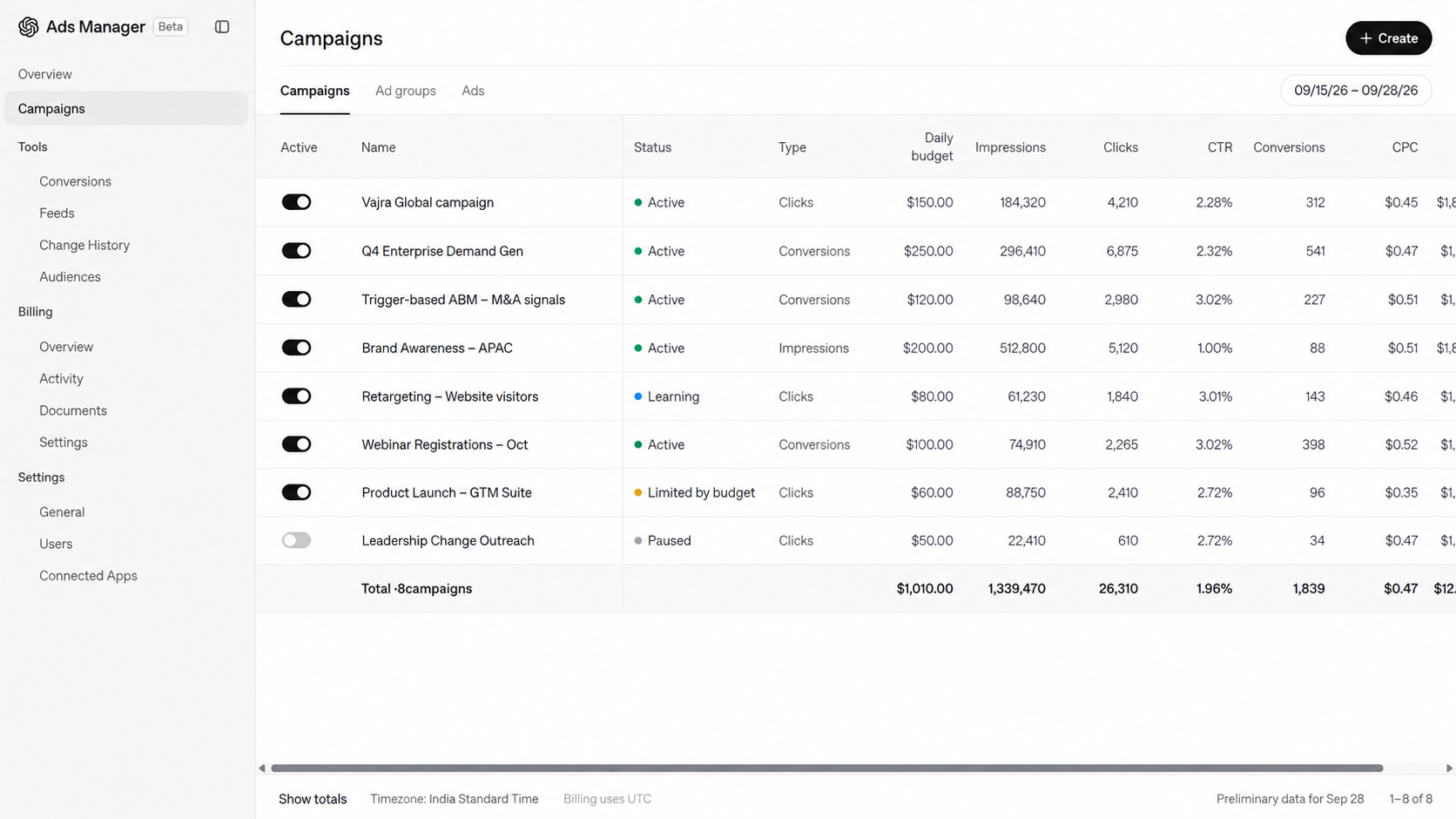
A Conversation Carries More Than a Keyword
At the ad-group level, advertisers do not build keyword lists. They provide context hints describing the conversations, topics, customer needs or situations where the product or service would be relevant. These hints act as contextual signals that help ChatGPT decide when an ad may be relevant, and they are not exact-match keywords. Instead of targeting only "CRM software", an advertiser could write: "Businesses looking for a CRM to manage sales pipelines, automate follow-ups and integrate customer data."
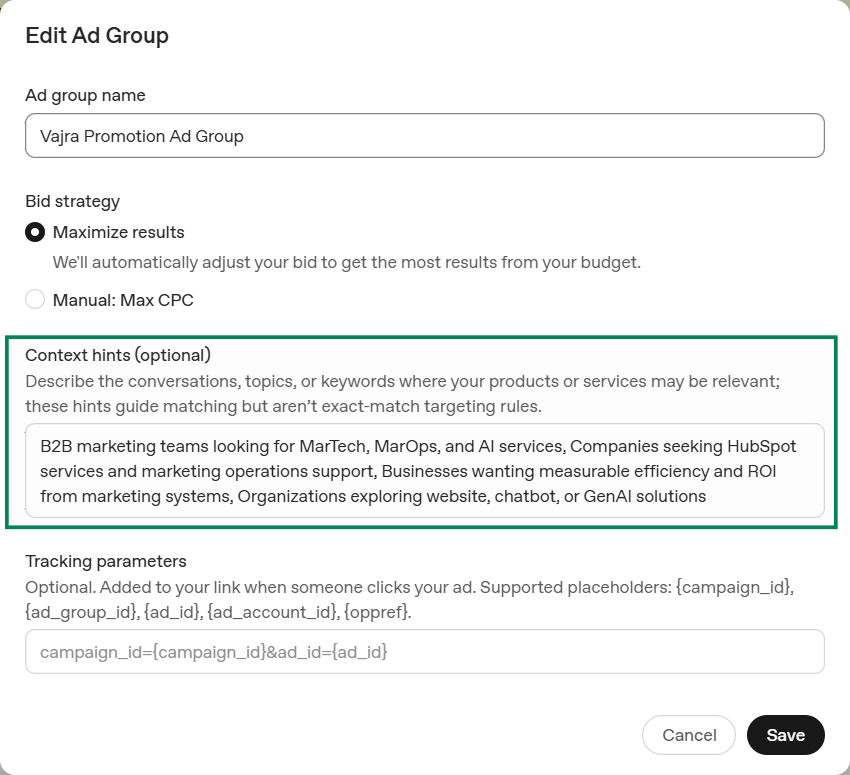
Context hints set at the ad-group level, from our own ChatGPT Ads campaign. They describe situations and needs rather than keywords. (ChatGPT Ads Manager, September 2026)
A search query is a few words. A conversation carries the whole problem: what the user is trying to do, what they have already ruled out, and what they are comparing. Brands can now reach people while they are working through a decision, and not only when they type a phrase.
OpenAI says the system draws on four groups of signals when it selects an ad. These are the context and intent of the current conversation, the ad's destination URL, title and copy, the context hints and targeting selections the advertiser provides, and, where the user has enabled personalisation, signals from their broader ChatGPT use. Ads sit below ChatGPT's response and are labelled as sponsored, kept visually separate from the answer. Each ad consists of a headline, description, image and destination URL, and the platform offers AI-assisted creative generation and text customisation that can adapt messaging to the context of a conversation.
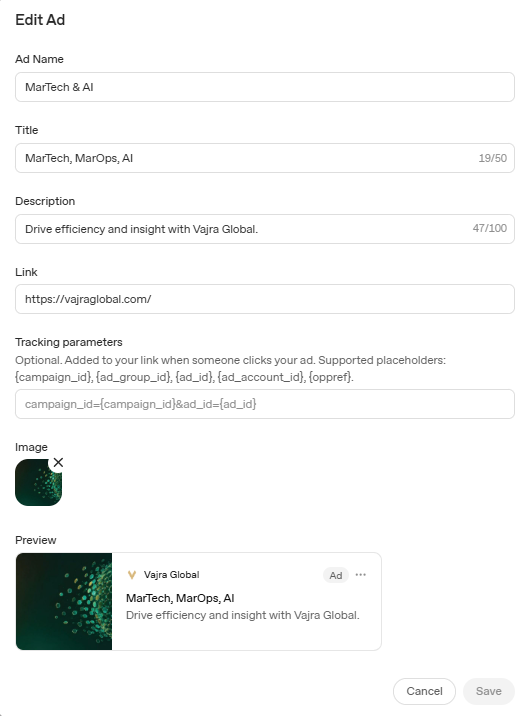
Ad-level setup: a title of up to 50 characters, a description of up to 100, a link, an image and a live preview of how the ad will appear. (ChatGPT Ads Manager, September 2026)
The rest of the setup will feel familiar to performance marketers. At the campaign level, advertisers choose an objective (Views, Clicks or Conversions), a budget and duration, geographic targeting, and platforms (Android app and web, iOS app and web, and desktop web). They also set a conversion event where applicable. Custom audiences can be built from customer lists using email addresses, phone numbers, hashed email or phone numbers and GAIDs, and included or excluded at campaign level.
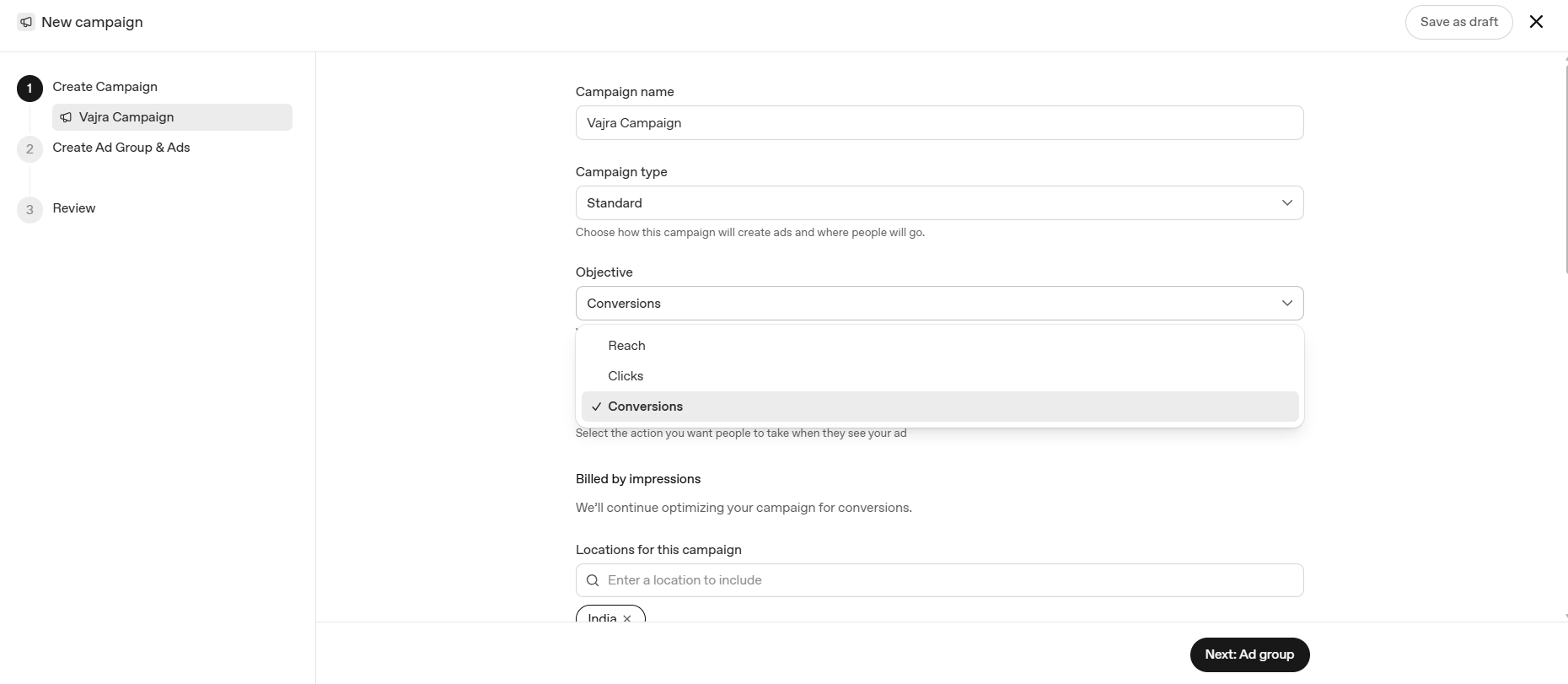
Campaign-level setup: choose an objective (Reach, Clicks or Conversions) and target locations. Conversion campaigns are billed by impressions while still optimising for conversions. (ChatGPT Ads Manager, September 2026)
A Young Channel Moving Fast
OpenAI began testing ads in ChatGPT in the US on 9 February 2026. In India, ads started appearing for Free and Go users on 27 August 2026, and self-serve access to Ads Manager opened on 4 September, with daily budgets starting at Rs 725. OpenAI reports that ChatGPT Ads reached a $1 billion annualised revenue run rate in less than 200 days, and that tens of thousands of advertisers now use it.
Ads are shown to Free and Go users only. Plus, Pro, Business, Enterprise and Edu accounts do not see them, and neither do users under 18. That detail matters later, when we get to B2B.
Where the Results Are Coming From
Eight months after launch, real performance data is starting to appear. The brands reporting the strongest results share one trait: their customers arrive already trying to solve a specific problem.
A note on sources. The brand results below come from OpenAI's published customer stories, so they show the best outcomes rather than an average. We pair them with independent benchmarks in the next section.
Buyers who are comparing and ready to act
Newegg used product feed ads to show PC builders the specific components and specs they were researching. It recorded a 3x return on ad spend over 28 days, and 7x during its two-week Fantastech Sale campaign. Visitors from ChatGPT were more likely to buy than visitors from its other channels.
Angi, the home services marketplace, started with about 20 home service categories and later expanded into nearly 30 more. Return on ad spend rose more than 38% from Q2 to Q3, and cost per lead fell 34% after it moved to conversion-optimised campaigns. Angi describes the in-conversation intent as a strong complement to traditional paid search.
Talkpal, an AI language learning app, saw ChatGPT Ads become one of its top three channels for new trials within two months. Against a native advertising channel it had run for over a year, it reported about 26% higher return on ad spend and about 51% lower cost per trial activation. The team built ad groups around different language-learning intents and used context hints to describe each need.
Buyers who are working through a task
Jotform, the forms and workflow SaaS, shows how far structured testing can go. More than 10% of its clicks became signups, with cost per signup about 30% lower than paid search and 60% lower than paid social. Those results came from more than 100 optimisations, including landing page improvements that lifted signup rates 2.5x and a move from reach to click campaigns that cut cost per click 4 to 5x. Its campaigns were built around specific use cases, which matches Stream's approach of writing copy around the questions developers were actually asking.
Contextual matching rewards advertisers who understand the customer's situation, so the strongest campaigns describe the customer's problem, with product names left in the background. A free trial, signup, quote request or product page all work well as the next step, because the easier the action, the more conversational intent turns into results.
These brands also judged the channel on more than the click. Stream looked at sessions and pipeline instead of CTR. Click-through rates look low next to search, which makes that the only fair way to evaluate this channel.
What Independent Benchmarks Say About Category Fit
Independent data gives a more measured picture. First Page Sage studied 17 verticals and projects ChatGPT Ads conversion rates between 0.2% and 5.7%, with the gap driven mainly by buyer intent, purchase price, journey length and how close the buyer is to a decision.
|
Stronger Performers |
Projected CVR |
Weaker Performers |
Projected CVR |
|
Higher Education |
5.7% |
Manufacturing & Distribution |
1.3% |
|
Construction |
3.2% |
B2B SaaS |
1.2% |
|
Oil & Gas |
2.8% |
Real Estate |
0.9% |
|
E-commerce / Retail |
2.5% |
Financial Services |
0.2% |
Source: First Page Sage, ChatGPT Ads Conversion Rate: 2026 Report
The top categories attract people further along in their decision, with fewer steps between the click and the next action. Lower-converting categories involve long evaluations, several decision-makers, regulation, financing or bigger commitments. In B2B SaaS, for example, the person who discovers a product is often not the one who signs off, and demos, security reviews and budget approval follow.
A low immediate conversion rate does not rule a category out. In a long sales cycle, someone who clicks today may become a customer weeks or months later. For these businesses, we ask whether the channel feeds the pipeline and whether we can track it all the way through, and we treat the first-click conversion rate as a secondary signal.
Some categories cannot use the channel yet. Ads for prescription drugs and legal representation are currently not allowed, and financial services advertising is restricted and requires approval.
Taken together, B2C is the easier fit today. Product feed ads, short purchase cycles and a large Free and Go user base line up well with ecommerce, education, home services and consumer apps.
B2B works best when the product is self-serve or product-led, and a free trial or signup is a natural next step, as with Jotform and Stream. Enterprise and high-ticket B2B, such as manufacturing, industrial equipment or complex SaaS, faces a further hurdle: decision-makers on paid ChatGPT plans will not see the ads at all. Reach is concentrated in the ad-supported user base, and that matters where the people who sign off use paid or business accounts.
What We Cannot See or Control Yet
The strengths of the channel come with trade-offs that marketers used to search will notice quickly.
1. Advertisers do not get access to users' chats, chat history, memories or personal details, and ads are not eligible to appear next to sensitive or regulated topics such as mental health and politics. This protects user trust, but it also means reporting will stay more aggregated than many marketers are used to.
2. In search campaigns, the search terms report shows exactly which queries triggered an ad. ChatGPT Ads, by contrast, uses conversational context and relevance signals, and context hints are guidance rather than exact-match rules, so there is less visibility into the intent behind individual deliveries.
3. Planning is harder too. There is no Keyword Planner equivalent for keyword-level volume forecasting, so actual CPC or CPM, conversion volume and scalability should be validated through controlled campaigns and never assumed from other platforms.
4. Placement raises a fourth question. On Google, paid ads sit above the answers, while ChatGPT ads sit below the generated response. In our view, by the time a user scrolls to the ad, the AI has already formulated an organic answer, which makes the ad a secondary element and not the primary recommendation.
How the September Update Answers Some of These Limits
On 16 September 2026, OpenAI began testing Sponsored Agents, rolled out prompt-driven campaign management inside ChatGPT, added AI-suggested ad copy and imagery, and connected ChatGPT Ads to HubSpot and Shopify as its first CRM and ecommerce partners. Our reading is that several of these changes respond directly to the limits above.
Sponsored Agents give the brand a place in the conversation after the click. A user can open a separate, labelled conversation with an agent backed by the brand. Advertisers now need to plan how their agent is configured, what it can answer, what it defers, and how it routes users to the website. The landing page is not the only post-click asset any more. For now, sponsored Ads are available only in the US, tested by select advertisers.
The HubSpot integration speaks to the tracking problem. HubSpot users can connect their ChatGPT Ads accounts to create campaigns, capture leads, trigger workflows and measure performance alongside other channels, so ad-generated interest can flow straight into an existing follow-up process. For enterprise B2B, where the value shows up further down the funnel, this integration matters more than the click.
Impression-billed conversion optimisation became generally available the same day. Campaigns optimise for conversions but are billed on impressions, which OpenAI now recommends for performance campaigns.
Paid and Organic Visibility Start From the Same Questions
The same conversational intent that decides whether an ad appears also shapes whether ChatGPT mentions a brand organically. Brands that understand the questions their customers ask AI assistants will write better context hints and build stronger answer engine optimisation (AEO). We believe the two should be planned together as one effort. It also means a pilot rarely ends up empty-handed. Even a campaign that underdelivers teaches a team how its buyers use AI assistants to make decisions.
How We Would Approach ChatGPT Ads
As performance marketers, our view is that ChatGPT Ads should be used along with your primary channels. Google, Meta and LinkedIn still carry most of the reliable, measurable demand for the majority of businesses, and that holds even with a new platform available. We would position ChatGPT Ads as an emerging additional performance channel, a layer on top of what already works.
In practice, that means four steps:
1. Set aside a small, ring-fenced test budget for a pilot.
2. Pick one or two use cases where your customers clearly research and compare before they buy.
3. Write context hints around the problems they are trying to solve, and leave out the product names you would normally bid on.
4. Judge the channel on traffic quality and cost per acquisition, and follow the leads through to pipeline, since click-through rate alone will undersell it.
A good fit today would be ecommerce, education, home services and consumer apps, along with self-serve or product-led B2B with a free trial or signup as the next step.
Enterprise and high-ticket B2B, such as manufacturing, industrial equipment or complex SaaS, calls for more caution, because the people who sign off often use paid or business ChatGPT plans that do not show ads.
If the pilot delivers good-quality traffic and conversions, scale it gradually alongside your core mix. Whatever the pilot shows, the marketers who start testing now will be best placed when this channel matures.
We are running more tests and will share what we learn as the results come in. If you would like to explore ChatGPT Ads for your business, please reach out to us. For two decades, search taught marketers to match ads to the words people type, and this channel asks us to match them to the problems people bring.
Authors

Rajesh Senthilvelavan
Performance Marketer
.svg)
.webp?width=100&height=100&name=Swetha%20Webp%20Image%20(Use%20this%20one).webp)
Swetha Sitaraman
Lead - Thought Leadership