
I recently attended a session at the Nasscom AI Summit in Mumbai where Rucha Nanavati, Chief Digital Transformation Officer at Mahindra & Mahindra, took the stage and said something that was equal parts generous and clarifying. Generous, because she was giving the room a genuine inside view of how one of India's most iconic enterprises actually evaluates its partners. Clarifying, because it crystallised something I've been observing for years without quite being able to name.
She said, “Don't blindly accept everything your client tells you. Push back. With clarity, with content, with context.”
That sounds like caution, but it’s more of an invitation, and it changes everything about how SMEs should be showing up.
I want to go beyond what was said in the room. Because the conversation Rucha opened deserves a longer, more honest exploration.
The Real Filter: Subject Matter Expertise Backed by Research
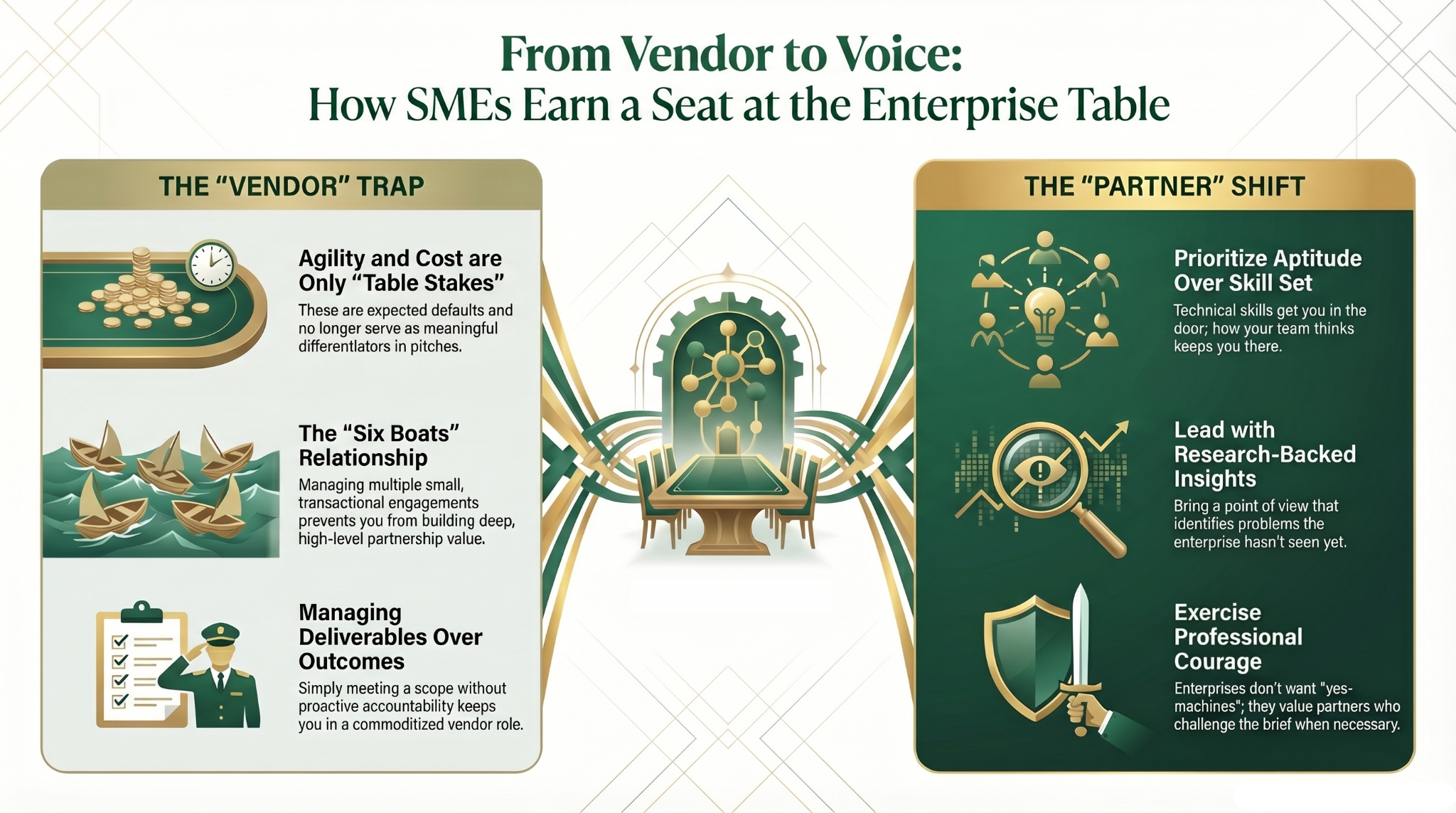
Most SMEs walk into an enterprise conversation with the same script: we're agile, we're cost-effective, here's our deck. And most enterprises nod politely and move on. Not because the SME wasn't capable, but because it sounded like every other SME they met that week.
Agility and value-for-money are table stakes. They're not your story or differentiator.
What large enterprises are actually hunting for (and quietly struggling to find) is an SME that ‘thinks’. One that has done the research before entering the room. One that brings a point of view, not just a portfolio. There's a world of difference between saying "we've done this before" and saying "here's what we've learned, here's where this is heading, and here's why your current approach might be creating a problem you haven't seen yet."
The first is a vendor. The second is a partner. Enterprises are desperate for the second and drowning in the first.
The Counterintuitive Skill: Being Proactive, Being Present
I’ve watched this pattern for a while now: an SME wins a small engagement, delivers well, and then goes silent, waiting and hoping for more work. The enterprise, meanwhile, has already moved on to its next problem, which the SME could have absolutely helped with had they shown up proactively instead of waiting to be invited.
Rucha made this point cleanly - “Insist on QBRs. Be proactive. Don't manage deliverables. Manage outcomes instead. And when something isn't working, say so before the client figures it out themselves.”
That's not just good practice. That's also how trust gets built in enterprise relationships. They don't need you to be perfect. They need you to be accountable.
The SMEs that graduate from "vendor we use" to "partner we call first" are rarely the ones with the flashiest capabilities. They're the ones who showed up consistently, told the truth, and cared about the client's business as much as the client did.
Aptitude Over Skill Set: The Long Game
The other thing Rucha said that I can't stop thinking about: aptitude over skill set.
At a time when AI is compressing execution timelines and equalising technical capability, the question enterprises are really asking is - how does this team think? Can they navigate ambiguity? Will they tell me what I ‘need’ to hear or what I ‘want’ to hear? Do they understand my business well enough to surprise me with an insight I didn't have?
Skill sets get you in the door. Aptitude keeps you in the room.
This matters especially now. The SMEs that will thrive in the next five years aren't the ones racing to add more tools and certifications to their pitch. They're the ones investing in the quality of their thinking. They are building genuine domain depth, backing their perspectives with research, and having the confidence to challenge a brief when it is wrong.
That last part is harder than it sounds. It takes a kind of professional courage that many SMEs don't give themselves permission to have. But here's what I've learned: enterprises don't want a yes-machine. They want someone who will walk in and say, "I think you're solving the right problem the wrong way. Let me show you why."
The Boats and the Yacht: A Metaphor Worth Unpacking
There's a metaphor I keep coming back to: six boats versus one yacht.
A lot of SMEs run six small, transactional engagements with the same enterprise - each one contained, each one carefully scoped to avoid risk. The revenue might add up, but the relationship never does. You stay a vendor because you keep acting like one.
The yacht is the deep partnership. Harder to build, slower to develop, but the kind of relationship where you get called before the RFP goes out. Where your input shapes the problem statement, not just the response to it. Where you're not competing on price because no one is quite sure how to replace the thinking you bring.
That's the goal. And it's more achievable than most SMEs believe, if they're willing to stop pitching and start contributing.
The Human Premium in the Age of AI
AI is compressing timelines, equalising technical capability, and quietly making execution a commodity. In that world, the SMEs that will matter most to enterprises are not the fastest or the cheapest. They're the ones with the courage to think out loud, the discipline to follow through, and the wisdom to know the difference between what a client is asking for and what they actually need.
The enterprise table was never behind closed doors. It was simply saving a seat for those ready to contribute.
Authors

Deepa Venkataraman
Head of Innovation & Market Development
.svg)